
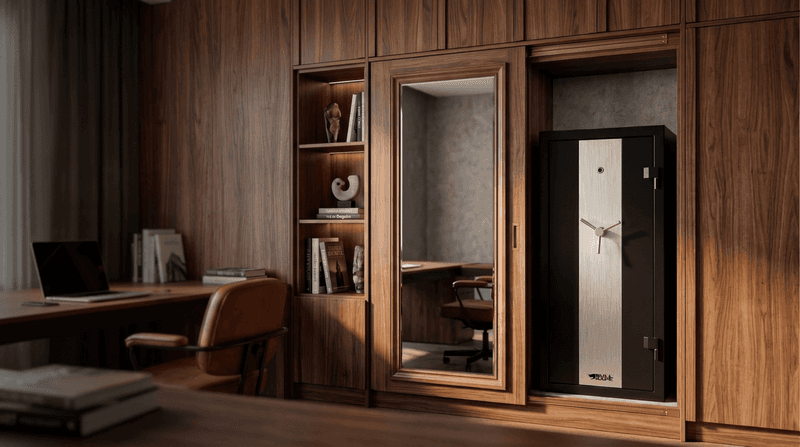
Having a safe at home or in the office is one of the smartest decisions you can make to protect what you value most: money, jewelry, important documents, weapons or family heirlooms. However, buying a good safe is not enough if it is visible to anyone. Location and camouflage are as important as the quality of the model you choose.
In this complete guide we explain how to hide a safe strategically, what mistakes you should avoid and what ideas work best depending on the type of safe and the space you have. If you want to raise the level of security in your home or business, keep reading: here is everything you need to know.
Why it is so important to hide a safe at home
A safe fulfills its deterrent and protective function when, in addition to being resistant, it remains hidden from view. Although quality models have certifications, no box is 100% inviolable if a thief has the time and the necessary tools. Therefore, disguising a safe inside the home works as an additional layer of protection that slows down and even prevents a robbery.
Most home burglaries last less than 10 minutes. If the intruder does not locate the safe within that time, he or she will most likely abandon the attempt. This is where the true importance of hiding a safe correctly comes in: combining a good model with a smart location multiplies the level of protection of your assets and drastically reduces the chances of loss.
What to consider before hiding a safe
Before thinking about ideas for hiding a safe, you should evaluate three key elements: the type of safe, its size and the need for anchoring. Hiding a small safe inside a closet is not the same as camouflaging a large-volume fireproof box designed for sensitive documents.
You should also consider frequency of use. If you need to access it daily, hiding it behind heavy furniture or partitions will not be practical. The balance between accessibility and discretion is what defines a good camouflage strategy. A safe that you can’t comfortably open will end up being misused or left open, defeating its purpose.
Types of safes and their best hiding strategy
Each type of safe requires a different camouflage technique:
- Built-in safe: designed to be integrated into the wall, making it one of the easiest to hide using pictures, mirrors or decorative panels.
- Overlay safe: requires creative camouflage inside cabinets, furniture or shelves, since its volume is visible.
- Floor: ideal for hiding under carpets, parquet or tiles, maintaining discreet access.
- Fireproof: Due to their size, they are usually located in technical areas or locker rooms, where they are less obvious.
There is no point in hiding safes if it is not properly anchored. A small model without fixation can be torn off and opened outside the home. Make sure you anchor the box to the floor or a supporting wall before thinking about how to camouflage it. This step is especially critical in stacked safes, where the weight alone is not enough to prevent theft.
How to hide a safe on the wall without being noticed
Built-in boxes are the most popular in homes and offices precisely because of their ability to go unnoticed. The most common technique is to cover it with a painting, a mirror or a decorative panel that matches the rest of the room.
For camouflage to be truly effective, the element that covers it must be coherent with the decoration. A painting that is too large, poorly aligned or with a frame that attracts attention can give away what is behind it. You can also integrate the box behind a built-in bookcase, a custom living room piece of furniture or even replacing a false panel inside a built-in wardrobe. The more natural the integration, the better the concealment.
Ideal elements to camouflage it on the wall
- Pictures with thick frame and neutral theme
- Full wall decorative mirrors
- Wooden or upholstered panels to match the room
- Sliding or hidden hinge shelving
How to hide a safe in a closet effectively
Hiding a safe in a closet is one of the most used solutions, especially in bedrooms and dressing rooms. However, this is also one of the first areas that a thief checks, so simply putting it inside the closet is not enough: it must be camouflaged within it.
An effective technique is to build a double bottom, hiding the box behind a false panel or behind removable drawers. You can also cover it with folded clothes on upper shelves, hide it inside a locked suitcase or integrate it into a lower drawer with a removable lid. The key is that, when you open the closet, nothing reveals the presence of the safe: no suspicious spaces, no panels that seem out of place, no gaps with no logical explanation.
Ideas to hide a safe in other areas of the home
If your safe is not built-in or fits comfortably in a closet, there are many other ideas for hiding a safe. The important thing is to choose places that are unusual for a thief, avoiding common suspects such as the master bedroom or office, which are usually the first rooms inspected. Some effective locations include inside a kitchen base unit, inside a storage bench, under stairs or in technical areas such as the boiler room or laundry room. Another increasingly popular option are camouflage safes, designed to look like everyday objects (books, plugs, cleaning products) and offering a level of discretion that no homemade camouflage can match.
Original (and not very obvious) places
- False floor in a pantry
- Interior of a TV cabinet with folding door
- Washing machine room, after the appliances
- Basement or storage room (always with anchoring and anti-humidity protection)
- False plug or decorative light box
How to camouflage a safe without making these mistakes
Many people believe that with hide safe everything is already solved, but there are errors that can easily give it away. The first and most common is to choose a place too obvious: the main closet in the bedroom, the office or behind the first painting in the living room are the points that any experienced thief checks first. Hiding is not just covering; is to choose well.
Another recurring failure is discussing the safe with third parties or leaving visible clues, such as keys, access cards or the instruction manual in view. Furthermore, not anchoring the box, placing it in humid areas (especially fire-resistant areas, which may affect its sealing) or leaving marks on the floor and wall during installation are errors that compromise both the concealment and the integrity of the safe itself.
Final tips for hiding a safe and maximizing your security
Beyond how to hide a safe, remember that security is a complete system. A well-concealed, anchored and certified safe, combined with an alarm, good manners and discretion, offers the real level of protection you are looking for. Don’t show off your safe, change the combination periodically and limit as much as possible who knows its exact location.
At Bullsafe you will find certified safes for residential, commercial, fireproof and gun use, with personalized advice to choose the model that best suits your home, your desired level of protection and the space where you plan to hide it. Because protecting your assets starts by choosing well, installing better and camouflaging intelligently.